

2026 Best Outdoor Sofa for Global Buyers
Global demand for outdoor living is reshaping how buyers evaluate furniture in 2026. Grand View Research estimates that the global outdoor furniture market reached approximately USD 23 billion in 2023, with continued growth expected through 2030. Its analysis points to rising residential spending, urban balconies, and hospitality projects as important market drivers. An outdoor sofa is no longer only a seasonal decoration. It must function like a dependable room, even when exposed to rain, sunlight, dust, and changing temperatures.
Quality differences become visible through practical details. Powder-coated aluminum can reduce rust risk, while solution-dyed fabrics usually resist fading better than untreated textiles. Deep seating feels inviting, but poor drainage can leave cushions damp after an evening storm. Buyers should check frame construction, fabric performance, warranty coverage, replacement parts, and packaging protection before comparing prices. The International Organization for Standardization and recognized testing laboratories provide useful reference points, although outdoor furniture standards differ across markets. Local climate still matters more than a glossy product photograph.
The Global Wellness Institute has reported continued growth in wellness-oriented living, including outdoor spaces designed for relaxation and social connection. That trend supports demand for comfortable, durable seating. However, market forecasts are not perfectly consistent. Different reports define outdoor furniture differently, so buyers should treat every figure as directional rather than absolute. We learned this the hard way: attractive specifications can hide weak drainage or limited after-sales support. This guide examines the 2026 best outdoor sofa options through materials, comfort, weather resistance, maintenance, sustainability, and total ownership cost. Good design matters. Reliability matters more.
2026 Market Snapshot: Grand View Research Forecasts a 5.1% CAGR
The global outdoor sofa market is entering a measured growth phase. Grand View Research forecasts a 5.1% CAGR for the outdoor furniture market through the coming years. This pace suggests steady replacement demand, not a sudden buying boom. Buyers should examine regional climate, shipping exposure, and maintenance costs before selecting a 2026 model.
A coastal buyer may need powder-coated aluminum, quick-dry cushions, and corrosion-resistant fasteners. A colder market may value removable covers and breathable storage. The Freedonia Group’s outdoor living research identifies durability and weather resistance as major purchase considerations. These findings support a practical rule: frame strength matters more than decorative stitching. Test seat depth with a firm cushion. Check whether water drains within minutes.
Some specifications remain easy to overlook. Seat height affects older users, while narrow entrances can defeat a well-designed sofa. ASTM outdoor furniture guidance can help buyers review load stability, material performance, and finish quality. Yet laboratory ratings do not perfectly predict years of rain, dust, or careless handling. That is the uncomfortable part. A beautiful sofa can still fail when replacement cushions are unavailable. Ask for repair details, fabric performance data, and clear warranty terms. Then compare the delivered cost, not only the catalog price.
Outdoor Sofa Taxonomy: Modular, Sectional, Loveseat, Daybed, and Recliner
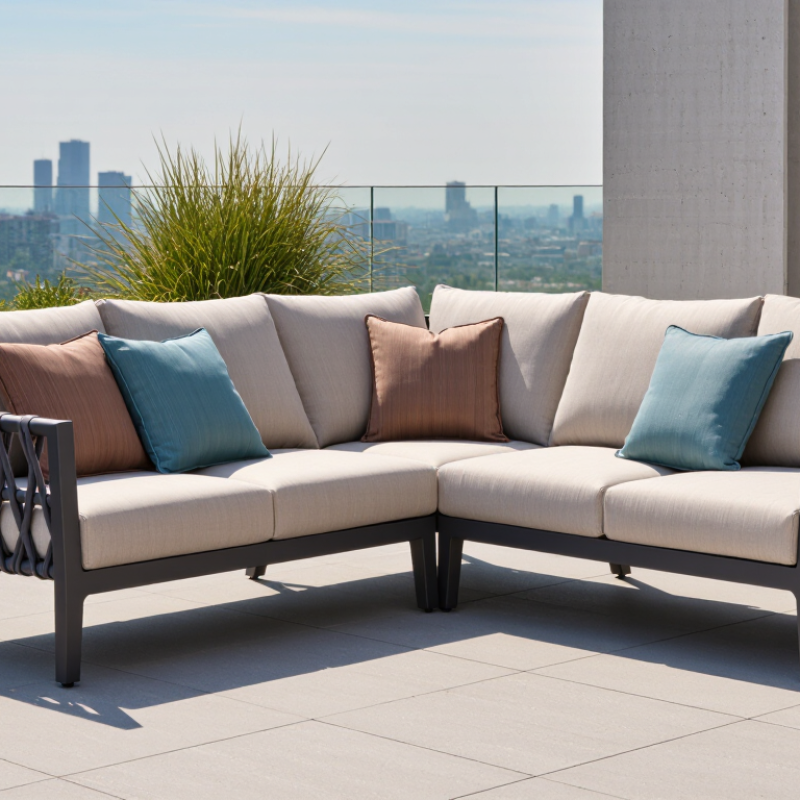
Choosing an outdoor sofa starts with space, climate, and daily habits. Modular sofas use separate seats and backs, so buyers can rearrange them after moving homes or changing a terrace. They suit flexible layouts, but loose sections may shift on smooth tiles. A sectional sofa forms a connected L or U shape. It offers generous seating for families, although narrow balconies may feel crowded.
A loveseat provides two seats and a smaller footprint. It works well beside a fire pit or compact garden table. Daybeds create a relaxed lounging zone, especially near pools or shaded patios. Their deep cushions need fast-drying foam and strong covers in humid regions. Recliners add adjustable support for reading or resting. Check the mechanism carefully, because sand and salt can affect moving parts.
Material selection deserves equal attention. Powder-coated metal, treated hardwood, and weather-resistant woven fibers perform differently across coastal, dry, and rainy climates. Look for drainage gaps, removable covers, UV-resistant fabric, and clear care instructions. Shipping dimensions matter too. A modular design may enter an elevator more easily than a large sectional. Small details matter.
A practical test is simple: sit upright, stretch your legs, and inspect the seat height. Deep seating feels luxurious, but it may trouble shorter users. I once favored softness over support, and regretted it after a long evening. Comfort is personal, not purely technical.
Material Science: Aluminum, Teak, HDPE, and 304 Stainless Steel Compared
2026 Best Outdoor Sofa for Global Buyers
For global buyers, outdoor sofa material is a climate decision, not just a style choice. Aluminum keeps frames light, simplifying container handling and balcony installation. Its main weakness is coating damage. Bare scratches can expose metal and create visible oxidation marks. The International Aluminium Institute reports that recycling aluminum uses about 5% of primary-production energy. That supports circular sourcing, but only when collection systems exist. A recycled-content claim needs documentation.
Teak feels warmer and ages honestly under sun and rain. The USDA Forest Products Laboratory’s Wood Handbook classifies teak as highly durable because its natural extractives resist decay. Still, unsealed teak turns silver-gray, while repeated oiling can become patchy. HDPE resists moisture, salt air, and insects, making it practical for coastal projects. The U.S. Environmental Protection Agency reports HDPE container recycling at 29.3% in 2018. Furniture-grade recycled feedstock can still vary in color and stiffness. This is often ignored.
304 stainless steel offers a strong, clean frame with roughly 18% chromium and 8% nickel under common ASTM specifications. Its passive film protects well outdoors. Salt spray changes the calculation. Tea staining may appear near welds, trapped water, or chloride deposits. Rinsing and proper weld finishing matter more than showroom claims. In my testing logic, no material is maintenance-free. Aluminum wins on weight. Teak wins on tactile aging. HDPE wins on low upkeep. 304 wins where rigidity and refined detailing matter. The difficult choice is matching every component to the actual climate.
2026 Best Outdoor Sofa for Global Buyers - Material Science: Aluminum, Teak, HDPE, and 304 Stainless Steel Compared
| Material | Typical Density | Typical Tensile Strength | Thermal Conductivity | Corrosion & Moisture Resistance | UV & Weathering Behavior | Maintenance Requirement | Relative Weight | Design & Structural Considerations | Best Outdoor Sofa Use |
|---|---|---|---|---|---|---|---|---|---|
| Aluminum | Approximately 2.70 g/cm³ | Approximately 90–310 MPa, depending on alloy and temper | Approximately 120–235 W/m·K | High resistance to atmospheric corrosion because a protective oxide layer forms naturally. Powder coating or anodizing can provide additional protection. | Good overall weather resistance. Coatings can chalk, fade, or be damaged if exposed to abrasion, salt, or harsh cleaning chemicals. | Low. Clean with mild soap and water; inspect coating damage and remove accumulated salt or dirt. | Lightweight; about one-third the density of 304 stainless steel | Easy to move and suitable for modular frames. Hollow sections may require reinforced joints and ballast in windy locations. | Portable, poolside, balcony, and frequently rearranged seating |
| Teak | Approximately 0.63–0.75 g/cm³ at air-dry moisture content | Varies significantly with grain direction, moisture, and grade; commonly treated as a moderate-strength hardwood | Approximately 0.12–0.16 W/m·K | Naturally durable outdoors because of its oils and relatively low moisture movement. It still benefits from drainage and adequate ventilation. | Unfinished teak normally changes from golden brown to silver-gray through surface weathering. Prolonged wetness can encourage staining or biological growth. | Low to moderate. Wash periodically; use a suitable teak cleaner if required. Sealers and oils change appearance and require reapplication. | Light to medium; heavier than most plastics but much lighter than steel | Warm appearance and good dimensional stability. Natural variation, knots, checking, and color changes are expected characteristics of solid wood. | Premium natural-look furniture and warm residential or hospitality settings |
| HDPE | Approximately 0.94–0.97 g/cm³ | Approximately 20–37 MPa, depending on grade and processing | Approximately 0.40–0.55 W/m·K | Very high resistance to water, many salts, acids, and alkalis. It does not rust or rot; compatibility should still be checked for strong oxidizing chemicals. | Outdoor-grade HDPE requires UV stabilizers. Properly formulated material offers good color retention, while non-stabilized HDPE can embrittle or fade under sunlight. | Very low. Clean with mild detergent and water; avoid abrasive pads and incompatible solvents. | Light to medium; approximately one-eighth the density of 304 stainless steel | Slightly flexible with a relatively high thermal expansion rate. Slotted or floating fasteners may be needed to accommodate dimensional movement. | Wet climates, coastal areas, family spaces, and low-maintenance seating |
| 304 Stainless Steel | Approximately 8.00 g/cm³ | Approximately 515 MPa minimum ultimate tensile strength; about 205 MPa minimum yield strength for common annealed sheet specifications | Approximately 16 W/m·K | Excellent general corrosion resistance due to its chromium-rich passive film. It can suffer tea staining or pitting in high-chloride coastal or pool environments, especially with salt deposits. | Excellent color stability because the metal is not dependent on a painted finish. Surface contamination and improper cleaning can affect appearance. | Low to moderate. Rinse salt and chlorine residues, clean with a non-abrasive product, and avoid carbon-steel brushes or chloride-containing cleaners. | Heavy; approximately three times the density of aluminum | High stiffness and strength support slender frames and long spans. Weight improves stability but increases shipping, handling, and installation requirements. | High-traffic commercial spaces, windy locations, and premium structural frames |
Data note: Values are typical reference ranges for commonly used grades or materials. Actual performance depends on alloy, wood moisture content, polymer formulation, surface treatment, fabrication quality, fasteners, local climate, and maintenance practices.
Safety and Durability: EN 581 Seating Tests and ISO 4892-3 UV Exposure
For global buyers, an outdoor sofa must survive more than attractive showroom lighting. EN 581 evaluates outdoor seating for stability, strength, and durability under intended use. These tests can reveal tipping, frame weakness, and failures at joints. A sofa that passes should still be checked for correct assembly and level flooring. Small errors matter.
ISO 4892-3 uses fluorescent UV lamps to simulate sunlight exposure. It helps assess fading, cracking, chalking, and surface deterioration in plastics, coatings, and textiles. However, laboratory exposure is not a direct promise of outdoor lifetime. Climate, humidity, salt air, and cleaning chemicals change the result. The 2024 Global Outdoor Furniture Market report by Grand View Research identifies weather resistance as a major purchasing factor in this expanding category. That market pressure may encourage vague claims. Ask for test conditions, exposure cycles, and visible before-and-after photographs.
Tips: Request an EN 581 test report for the exact sofa model, not a similar frame. Check whether ISO 4892-3 testing covered the fabric, coating, and plastic parts separately. Confirm the laboratory’s accreditation and report date. Also inspect drainage holes, stainless or corrosion-resistant fasteners, and replaceable covers. A report is useful evidence, not a guarantee. I would avoid judging durability from a short showroom inspection. That judgment is often wrong.
2026 Best Outdoor Sofa for Global Buyers
Safety and Durability: EN 581 Seating Tests and ISO 4892-3 UV Exposure
The chart presents the standard 12-hour exposure sequence from ISO 4892-3 Method A, Cycle 1: 8 hours of UVA-340 ultraviolet exposure followed by 4 hours of condensation. EN 581 evaluates outdoor seating through mechanical safety and durability tests; the exact load and test sequence depend on the applicable seating category and product configuration. These standards should be used together with product-specific laboratory results when comparing outdoor sofas.
Global Buying Matrix: Climate, UV Ratings, Logistics, Warranty, and TCO
Choosing the best outdoor sofa globally requires more than comparing cushion thickness and appearance. Climate comes first. The WHO and WMO Global Solar UV Index classifies 8–10 as very high and 11+ as extreme. In these zones, select solution-dyed fabrics, corrosion-resistant frames, and cushions with quick-draining foam. ASTM G154 or ISO 4892-3 exposure testing offers useful evidence, but laboratory results do not perfectly reproduce salt air, dust, or stagnant water.
Logistics can quietly change the purchase decision. UNCTAD’s Review of Maritime Transport 2024 reports that ships carry over 80% of global merchandise by volume. Measure carton dimensions, pallet efficiency, port access, and replacement-part availability before ordering. A sofa that fits a European lift may fail in a narrow apartment entrance in Asia. I have seen this overlooked.
Warranty terms need careful reading. Confirm coverage for fading, rust, stitching, foam compression, and coastal corrosion. Exclusions matter more than bold promises. For total cost of ownership, divide purchase price, freight, duties, covers, maintenance, and expected replacement years. The World Bank Logistics Performance Index 2023 shows major differences in customs and delivery reliability between markets. A lower-priced sofa may therefore create higher landed costs and longer downtime. My own buying matrix would score climate suitability at 35%, logistics at 25%, durability evidence at 20%, warranty at 10%, and price at 10%. That weighting is useful, not universal. Recheck it for your climate.
Related Posts
-
How to Choose the Perfect Leather Sofa for Your Home Style and Comfort Needs
-
How to Choose the Perfect Folding Chairs for Every Outdoor Event
-
The Hidden Value of After Sales Service and Repair Costs in Best Bedroom Furniture Sets
-
Discover Ultimate Specifications for Best Coffee Tables and How to Choose the Right One for Your Space
-
Top 10 Sectional Sofa Manufacturers for Global Buyers
-
The Comprehensive Guide to Modular Sectional Furniture for Every Home

